Many genealogy websites are free to search but not free to see. FamilySearch, run by a nonprofit, is free: you need a free account to search, and nothing there is charged. Below are 26 sources for the United States, Canada and abroad, each labeled with what you can do without paying.
Last reviewed 8 October 2026By Wren & Co., from the research behind Fill In the Dots
On this page
Short answer: FamilySearch, Find a Grave, WikiTree, the Internet Archive, the U.S. National Archives’ 1950 census website, Library and Archives Canada’s Census Search and FreeBMD are free to search and free to see. Ancestry and MyHeritage are paid sites with some free features.
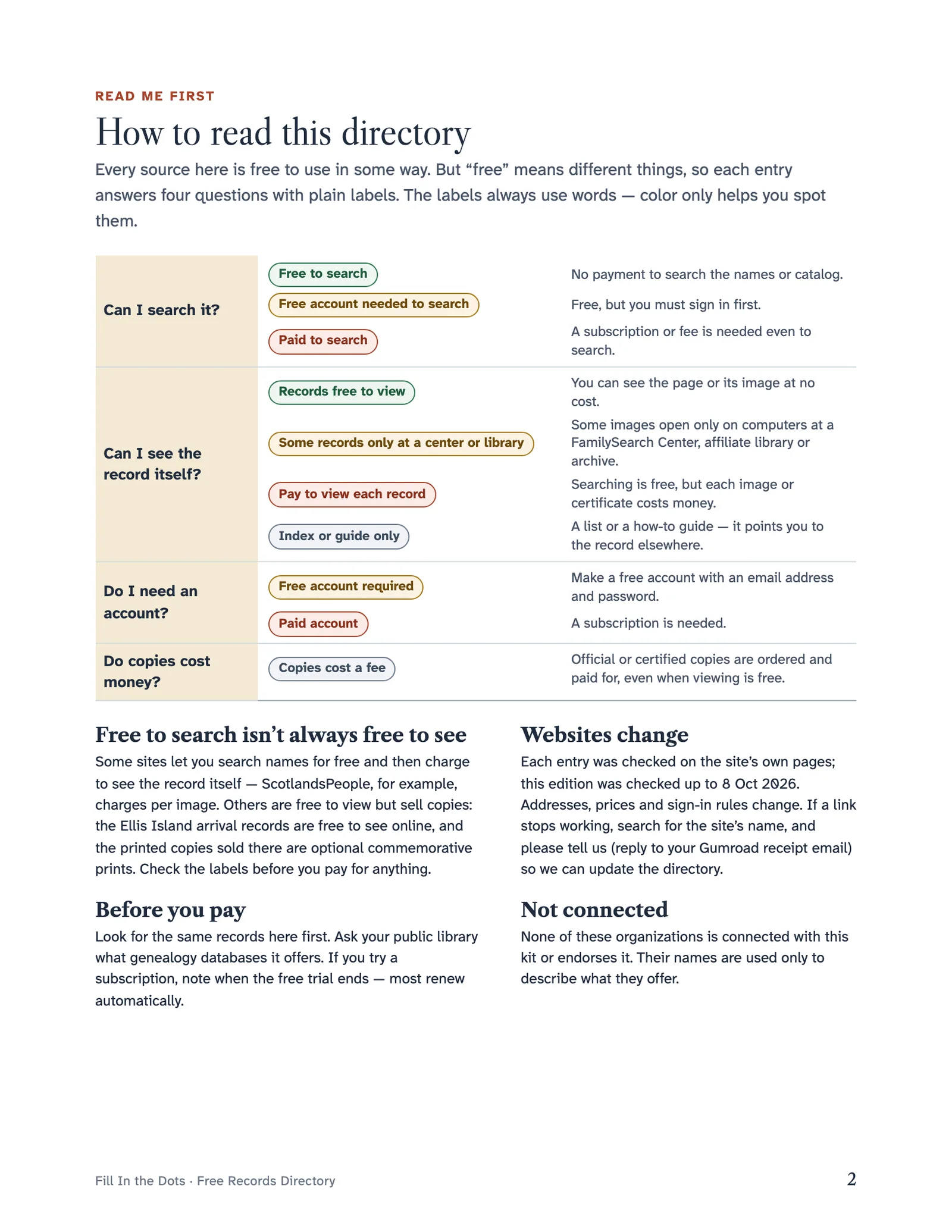
“Free” can mean four different things, so every source below answers four questions: can you search it free, can you see the record itself, do you need an account, and do copies cost money. The labels always use words; color only helps you spot them.
How do the big genealogy websites compare?
The big names at a glance (checked 8 October 2026)
Yes. FamilySearch says access to its records “is free and always will be free” (FamilySearch Help Center). You need a free account to search its historical records. Some images can be seen only at a FamilySearch center or affiliate library, because of the record owner’s terms (FamilySearch Help Center).
A page from the kit’s Free Records Directory, which answers the same four questions for every source.
Which free genealogy sites need no sign-up?
These let you search and see records without creating an account. Some offer a free account for extras, such as saving searches.
FamilySearch does need a free account to search its historical records, though its Research Wiki and catalog are open to everyone (FamilySearch Help Center).
Is there a free alternative to Ancestry?
FamilySearch is the closest. It’s free with an account and holds billions of records worldwide, including an index and images for every U.S. federal census from 1790 to 1950 (FamilySearch Research Wiki).
HeritageQuest Online works from home with a library card, if your library subscribes. It has U.S. federal censuses from 1790 to 1940, family and local histories, and city directories (ProQuest).
Ancestry’s free trial asks for a payment method and turns into a paid membership after two weeks unless you cancel (Ancestry Support). If you start one, note the day it ends.
If what you want from Ancestry is a place to build your tree, Gramps is free, open-source family tree software that keeps your tree on your own computer, with versions for Windows, Mac and Linux (Gramps on GitHub). It holds your tree; it doesn’t search records.
Can I see census records for free?
Yes, for every census that’s open to the public in the United States and Canada. Our free census records guide covers each year and how to search well.
United States, 1790 to 1940: images are free on FamilySearch with a free account (FamilySearch Research Wiki), and free on computers at any National Archives facility (National Archives). Federal censuses 1790–1950 are open; censuses from 1960 onward stay closed for 72 years (so 1960 is due for release in 2032). Most of the 1890 census was destroyed by fire in 1921.
England and Wales: free volunteer indexes for 1841 to 1911 on FreeCEN and FamilySearch. The 1921 census costs money online, but is free to see in person at The National Archives in Kew (The National Archives).
Can I find birth, marriage and death records for free?
Often, for older records. Indexes are usually free to search. Official certificates and copies usually cost a fee, and access to recent records is often limited.
United States: each state keeps its own. The CDC’s Where to Write for Vital Records lists every state office; certificates come from the state or county office, which sets its own fee. With a free account, FamilySearch has birth, marriage and death collections for many places, and its Social Security Death Index lists many deaths from 1962 on. Find a Grave is free for burials.
Canada: each province keeps its own. Nova Scotia Historical Vital Statistics has free images of births, marriages and deaths, and FamilySearch has Quebec’s Catholic parish registers from 1621 to 1979, free with an account. Most other provinces have a free index, with copies for a fee; the kit’s directory lists 9 provincial sources.
England and Wales:FreeBMD gives the free index reference for births, marriages and deaths from 1837. Certificates are ordered from the General Register Office for a fee.
Scotland:ScotlandsPeople indexes are free to search with an account. Each record image costs credits: 6 credits (£1.50) for a birth, marriage or death in October 2026, and prices may change.
Ireland:IrishGenealogy.ie has free images of civil birth, marriage and death registers, with no account.
Italy:Portale Antenati has free images of town birth, marriage and death registers, in Italian.
How do I find immigration records for free?
Arrivals in the United States: the Ellis Island arrival records cover the Port of New York and some other ports, with ship manifests free to search and see. A free account is only needed to save records.
Arrivals in Canada, 1865 to 1935:Library and Archives Canada’s passenger lists are free to search. Some lists must be viewed on site or ordered, and arrivals after 1935 are held by Immigration, Refugees and Citizenship Canada.
Naturalization in the United States: there is no single national index. The National Archives guide explains which court and agency holds the papers; copies cost a fee.
FamilySearch also has many passenger-list and naturalization collections, free with an account.
All 26 sources at a glance
Every source on this page, with what you can do without paying. Details and tips for each follow below.
What’s free on each site (all checked 8 October 2026)
The best free starting point for almost any family history search, from census records to church registers.
Free account needed to search
Some records only at a center or library
Good to know: You must sign in with a free FamilySearch account to search historical records (required since 13 Dec 2017). Most images are viewable at home once signed in, but some are restricted by record custodians: they show a camera-with-alert/restriction icon and can only be seen at a FamilySearch center or affiliate library, and a few only at the FamilySearch Library in Salt Lake City. Some collections are index-only with no image. Nothing is ever charged.
Finding where a relative is buried, a headstone photo, and links to family members’ graves.
Free to search
Records free to view
Good to know: Free to search and view, supported by ads and Ancestry. A free account is needed only to contribute (add memorials, photos, or request photos). Content is volunteer-entered, so dates can be wrong; there is a paid ad-free option.
Finding a headstone photo with the grave’s GPS location so you can walk right to it.
Free to search
Record access varies
Good to know: Basic search and standard-resolution headstone images are free. Paid tiers (now named Basic/Premium/Enterprise, from about $2.50 to $24.99 USD a month on the plans page, with AI ‘Cemetery Intelligence’ credits) add high-resolution images, exact GPS on the website, nearby graves and record hinting. Volunteers can earn paid features. Check the plans page for current prices.
Reading old family histories, local histories and city directories for free.
Free to search
Records free to view
Good to know: Public-domain books can be read and downloaded with no account. Newer (in-copyright) books are ‘borrow’ only: you need a free account, loans are usually 1 hour (some 14 days), up to 10 at a time, with no fees.
Viewing and contributing to a free, sourced, collaborative world tree with no paid tiers.
Free to search
Records free to view
Good to know: Completely free with no premium memberships. Anyone can browse; to edit or add profiles you register free and agree to the nine-point Honor Code. Living people are privacy-protected. Like any shared tree, verify with sources.
Checked 8 October 2026
Which big paid sites have free features?
Subscription sites with some free features, and the library editions that are free to use.
Building your own tree free and searching the handful of free collections; full records need a subscription or a library visit.
Some searching free
Records need a subscription
Free account required
Good to know: A free ‘registered guest’ account lets you search free databases, build and share trees, and see trees you are invited to. You can run searches but generally cannot view record images or transcriptions unless the collection is free, and cannot view other members’ public trees. Free trials require a payment method. Ancestry Library/Institution Edition is free inside many public libraries and the Archives of Ontario.
Trying a small online tree for free; most record viewing needs a paid Data subscription.
Free to search
Records need a subscription
Good to know: Basic family sites are free but capped at 250 individuals (all trees combined) and 500 MB of photos. Searching records is free, but viewing many records requires a Data subscription. Family Tree Builder desktop software is free (some features Premium-only). Free trials convert to paid plans unless canceled.
Using Ancestry’s records for free on a library computer instead of paying for a home subscription.
Search in person
Records viewable in a library
Good to know: Free, but only on computers or Wi-Fi inside a library that subscribes. The temporary home access offered during COVID ended in late 2021. No personal family-tree features. Ancestry and Fold3 are also free on computers at National Archives research facilities. Saving or printing options depend on the library (printing may cost).
Using census images and old county history books free from home with your library card.
Library card needed
Records free with a library card
Good to know: Not sold to individuals: you get in only if your public library (or state library) subscribes. Log in through your library’s website with your library card number. Home access is allowed (unlike Ancestry Library Edition). Content is a smaller subset of Ancestry’s; the 1950 census is not listed. Availability depends on your library.
Checked 8 October 2026
Free genealogy websites for the United States
National sources first. Each state also has its own archives and vital-records office.
Finding your parents or grandparents in the most recent census that is open to the public (1950).
Free to search
Records free to view
Good to know: No fee to search, view or download. The name index was created by AI/handwriting recognition and has errors, so also browse page by page using the address’s enumeration district. Anyone can suggest name corrections with the built-in transcription tool.
Searching and viewing digitized federal records for free, such as Dawes Rolls, some census years and military files.
Free to search
Records free to view
Good to know: No account needed to search, view or download digitized images. A free Login.gov account is optional, used for saving work, tagging and transcribing. Most NARA records are NOT digitized; for those you visit in person or order paid copies.
Free full-text searching of old newspapers for obituaries, marriages and local news about your family.
Free to search
Records free to view
Good to know: Moved into loc.gov in August 2025: chroniclingamerica.loc.gov now redirects to the new site; most old links work but some saved searches may not. Only selected titles and years are included, so a missing story may just be a missing paper. Text search relies on OCR, so try spelling variants.
Finding an immigrant ancestor’s ship manifest, especially for New York arrivals 1892–1924.
Free to search
Records free to view
Copies cost a fee
Good to know: Relaunched in 2026 and renamed; old heritage.statueofliberty.org and ellisisland.org addresses redirect. When this directory was checked (October 2026), search results and full manifest images opened without signing in. A free account is only needed to save records or searches and to buy items. Printed ‘Arrival Record’ copies cost $35 and are commemorative, not legal documents. Index corrections are now handled with FamilySearch.
Finding the right state office to order a birth, death, marriage or divorce certificate.
Free to search
Index or guide only
Copies cost a fee
Good to know: CDC/NCHS does not have or send certificates; you order from the state (or county) office, which charges its own fees and may limit who can get recent records. The page was last reviewed in 2022, so confirm fees and rules on the state’s own website.
Ordering a relative’s full military personnel file, including WWI, WWII, Korea and Vietnam-era service.
Some searching free
Index or guide only
Copies cost a fee
Good to know: Veterans and next of kin (unremarried surviving spouse, parent, child, sibling) generally get basic records free from non-archival files. Anyone may order archival files (left service 62+ years ago) for a fee: $25 flat fee for 5 pages or fewer, $70 flat fee for 6+ pages (most files). Records of more recent service are restricted for the general public. Online requests (eVetRecs) require identity verification through ID.me; otherwise mail or fax form SF-180. Email requests are not accepted. A 1973 fire destroyed about 16–18 million files (Army discharges Nov 1912–Jan 1960; Air Force Sept 1947–Jan 1964); NPRC can sometimes rebuild basic service facts from other records. Companies that charge for DD-214s are selling something NARA provides free to veterans and next of kin.
Checked 8 October 2026
Free genealogy websites for Canada
National sources. Birth, marriage and death records are kept by each province.
Free name search and free page images of every available Canadian census up to 1931.
Free to search
Records free to view
Good to know: Census returns open 92 years after the census, so 1931 is the latest available (under the 92-year rule, the 1941 census would open in 2033). All censuses from 1871 on are digitized microfilm images. The 1931 index was made by Ancestry’s handwriting AI and reviewed by FamilySearch; indexes have errors and some pages lost names when margins were cut off in filming. Pre-1871 censuses survive only for some areas. Newfoundland (not part of Canada until 1949) is not in these Dominion censuses.
Free access to old Canadian books, directories and LAC microfilm (land, military, Indigenous records) from home.
Free to search
Records free to view
Good to know: Free since 1 January 2019 (former paywall removed); no account or login required. Personal/non-commercial use; downloads may be rate-limited. Heritage microfilm is mostly browse-only (not name-indexed).
Reading a First World War soldier’s complete service file free online.
Free to search
Records free to view
Good to know: All surviving CEF files are digitized and free to view and download as PDF. Files usually do not describe battles; use the unit’s War Diaries for that. Second World War files are different: only some are open, and survivors’ files require a formal access request.
Finding a photo of an ancestor’s headstone in a Canadian cemetery.
Free to search
Records free to view
Good to know: Free; funded by donations and ads. Login/registration is for submitting photos. The domain canadianheadstones.ca forwards to /wp/; the site uses a browser check that may slow access.
Checked 8 October 2026
Free sites when your family came from abroad
National portals for some of the most common countries of origin.
Finding the free index reference (year, quarter, district, volume, page) for an English or Welsh birth, marriage or death so you can order the certificate.
Free to search
Records free to view
Good to know: Searching is completely free with no login. The images are scans of the printed index pages, not of certificates. Certificates are ordered from the GRO for a fee. A redesigned site is at https://www.freebmd2.org.uk/; the original site stays online.
A free, no-login census search for Britain when you want to try before paying a commercial site.
Free to search
Index or guide only
Good to know: Volunteer transcriptions only, no census images. Coverage is patchy by county and year. The ‘Member’ login is for volunteers, not a paywall.
The official source for Scottish ancestors, with free index searching and paid image views.
Free account needed to search
Pay to view each record
Copies cost a fee
Good to know: Index searching is free, but you register an account to explore the records. Images cost credits (1 credit = 25p): births, marriages, deaths, census and church register entries 6 credits (£1.50); wills 10 credits (£2.50); valuation rolls 2 credits. Some Virtual Volumes records are free to view but cost 2 credits to download. Official certificates are a separate paid service; in Oct 2026 the site warned processing was taking up to 22 working days. A fees consultation closed 4 Oct 2026, so prices may change.
Free images of Irish civil birth, marriage and death register pages, including Northern Ireland before 1922.
Free to search
Records free to view
Copies cost a fee
Good to know: Index and register images are free with no account, but you may be asked to tick an “I’m not a robot” box. Images are missing for deaths 1864-1870 and for some individual entries. Paper copies come from the GRO in Roscommon: research copy of an entry €5, certificate €20.
Free images of Italian town birth, marriage and death registers, with an English interface.
Free to search
Records free to view
Good to know: Browsing registers and the partial name index is free with no login. The site also has a ‘Request of certificates’ page for official copies (handled by State Archives). The registers themselves are in Italian. Not every town or year is online yet.
Checked 8 October 2026
How can you tell if a genealogy site is really free?
Ask the four questions before you type in a card number:
Can I search it for free?
Can I see the record itself, or only an index?
Do I need an account, and is it free?
Do copies or certificates cost money?
An index is a typed list of names and dates. Some sites let you search the index free and charge to see the record image itself; the record often holds more than the index shows.
Be careful with ads. Some sites reached from search ads charge for records that are free elsewhere. Check the official source first.
Read what a free trial asks for. If it takes a card, check when it turns into a paid membership: Ancestry’s does after two weeks unless you cancel. Set a reminder for the day before.
Ask your public library. Many libraries give members free use of databases that cost money elsewhere, some from home and some only on library computers.
How we checked these sites
Each site was checked on its own pages: its help articles, terms and search pages. The date beside each entry is the day it was checked. Prices and sign-in rules change, so the sources are re-checked about every six months. If a link has stopped working, search for the site’s name.
None of these organizations is connected with Fill In the Dots or endorses it. Their names are used only to describe what they offer.
Questions people ask
What is the best free genealogy website?
For most beginners, FamilySearch: it has billions of records from around the world and charges nothing, though you need a free account to search. Add Find a Grave for burials, and your national archives for census records: the National Archives’ 1950 census website in the United States, and Library and Archives Canada’s Census Search in Canada.
Can I use Ancestry for free?
Partly. A free account lets you build a tree and search Ancestry’s free index collections, but most record images need a subscription. Many public libraries offer Ancestry Library Edition free on their own computers. Its free trial asks for a payment method and turns into a paid membership after two weeks unless you cancel.
Is there a completely free genealogy website?
Several. Find a Grave, WikiTree, the Internet Archive, FreeBMD, the National Archives’ 1950 census website and Library and Archives Canada’s Census Search are free to search and to view, with no subscription.
How do I find my ancestors for free?
[Start with what you know](/how-to-start-a-family-tree): write down the names, dates and places you remember, and ask relatives. Then search FamilySearch with a free account, look for graves on Find a Grave, and check the most recent census that’s open to the public. [Write down every search](/genealogy-research-log), including the ones that find nothing.