FamilySearch (historical records search)
The best free starting point for almost any family history search, from census records to church registers.
- Free account needed to search
- Some records only at a center or library
Fill In the Dots takes you from a box of family papers to your first record searches in seven unhurried sittings. Every name, date and place gets a small mark that shows how you know it.
US$27One payment, instant download, no subscription

Fill In the Dots is a US$27 family history starter kit by Wren & Co. for beginners: a 50-page guide in seven sittings of about an hour, 21 pages of forms to print or type into, a research workbook, and a directory of 117 free record sources for the United States, Canada and abroad, each labeled with what you can do without paying.
7 files: the guide, the forms and the directory in both US Letter and A4, and a spreadsheet. Print what you need, as often as you like.
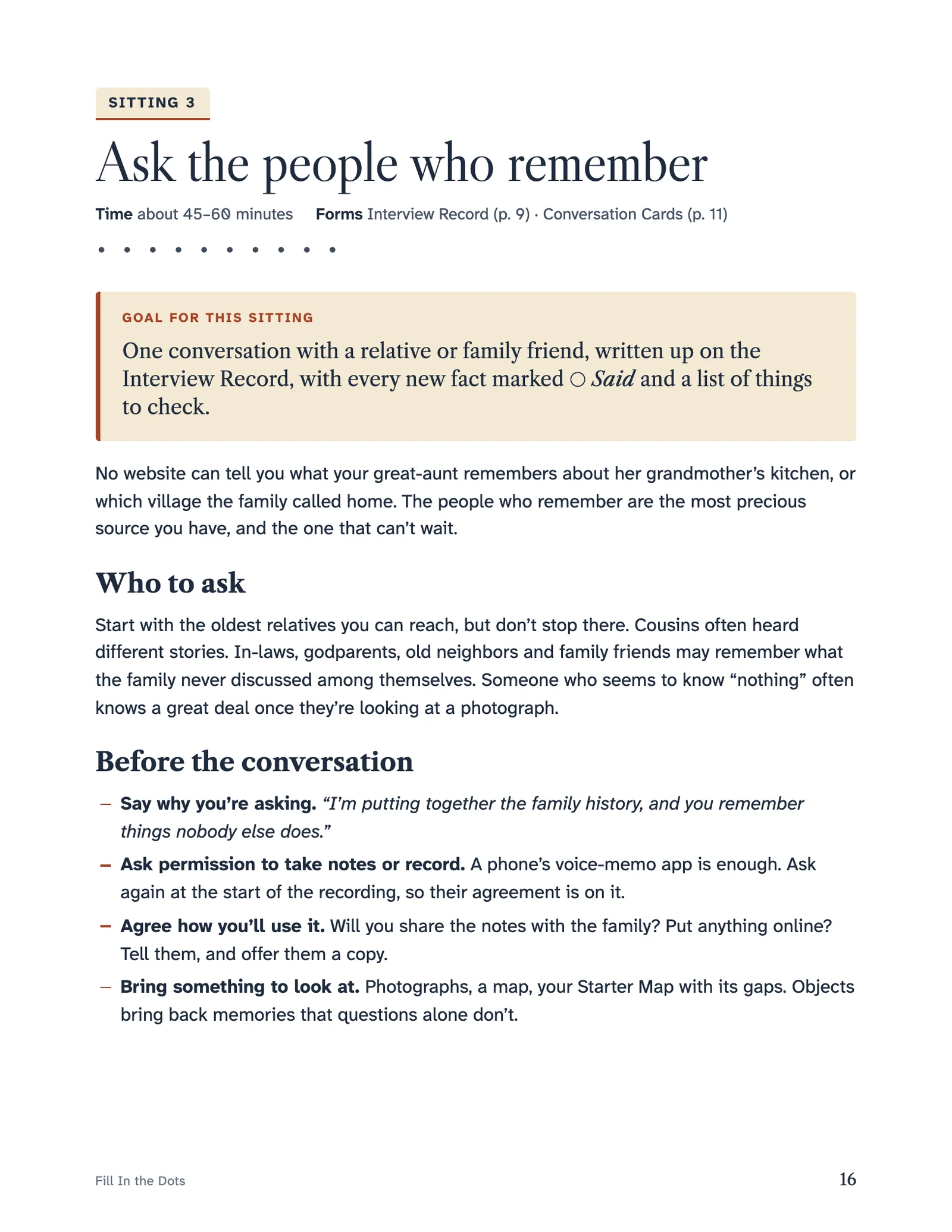
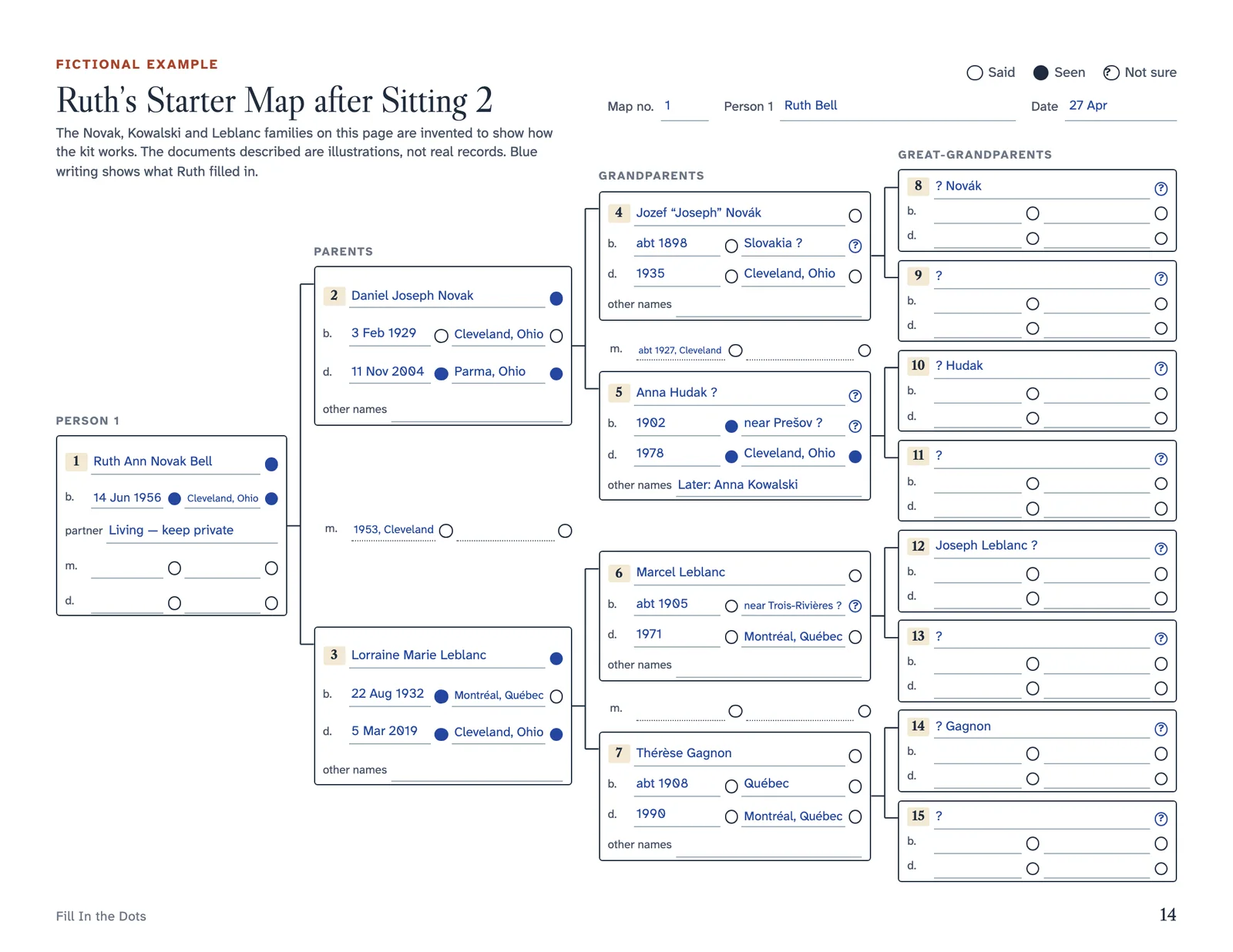
Seven sittings, each with one goal, one or two forms and a worked example.
PDF · 50 pages · US Letter and A4

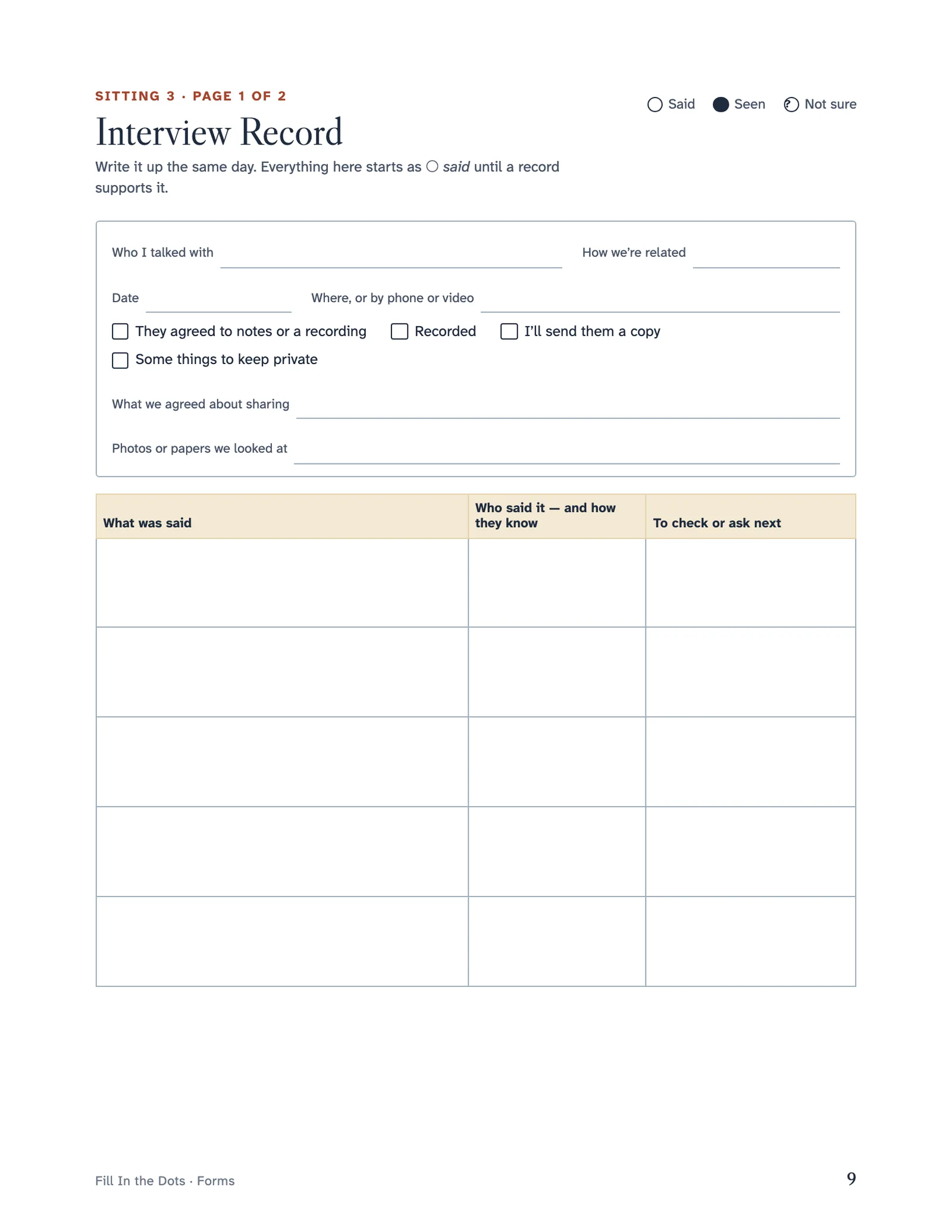
A four-generation Starter Map, family pages, an interview record, a research plan, a research log and more.
PDF · 21 pages · 1,129 fillable fields
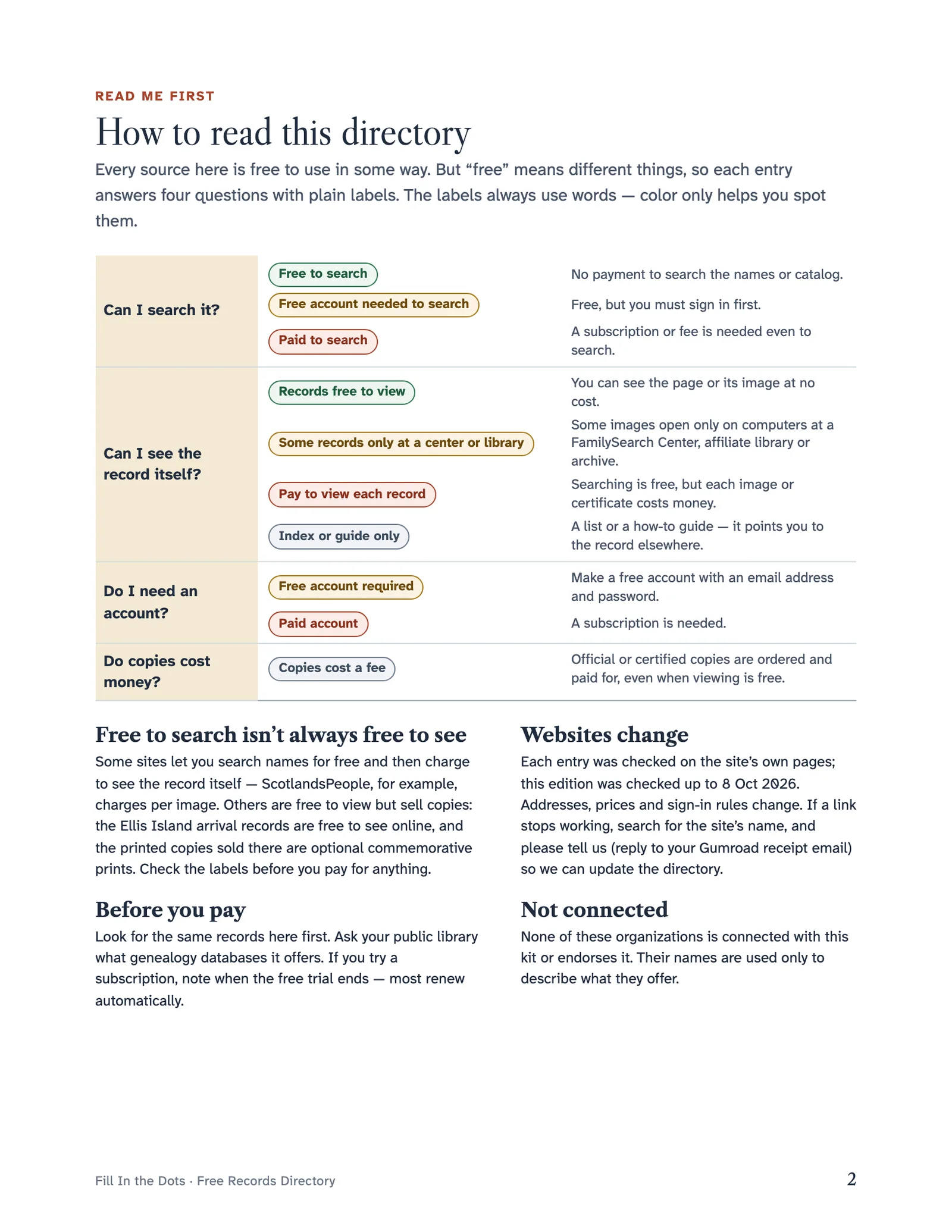
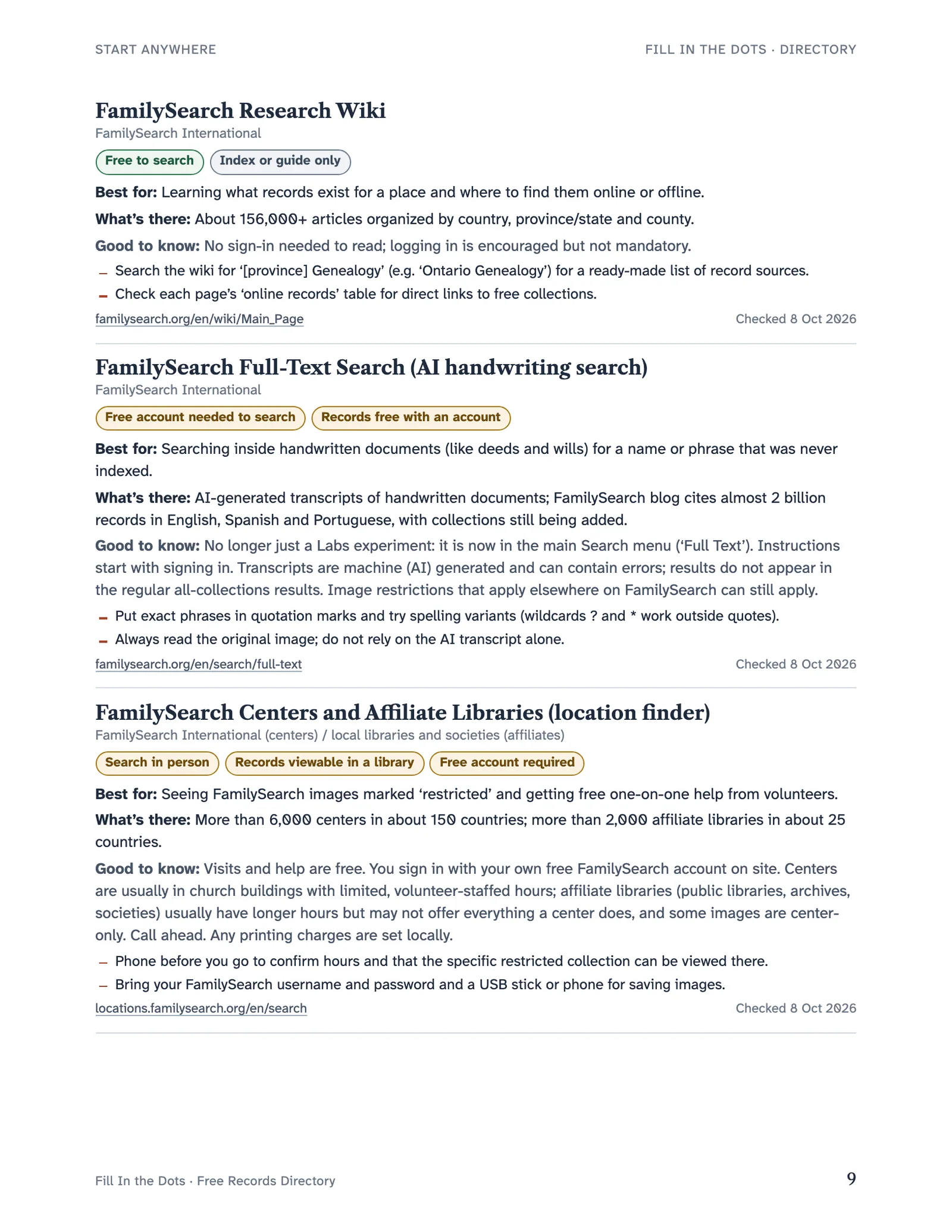
117 places to search without paying, with plain labels for what each one really lets you do.
PDF · 54 pages · clickable links
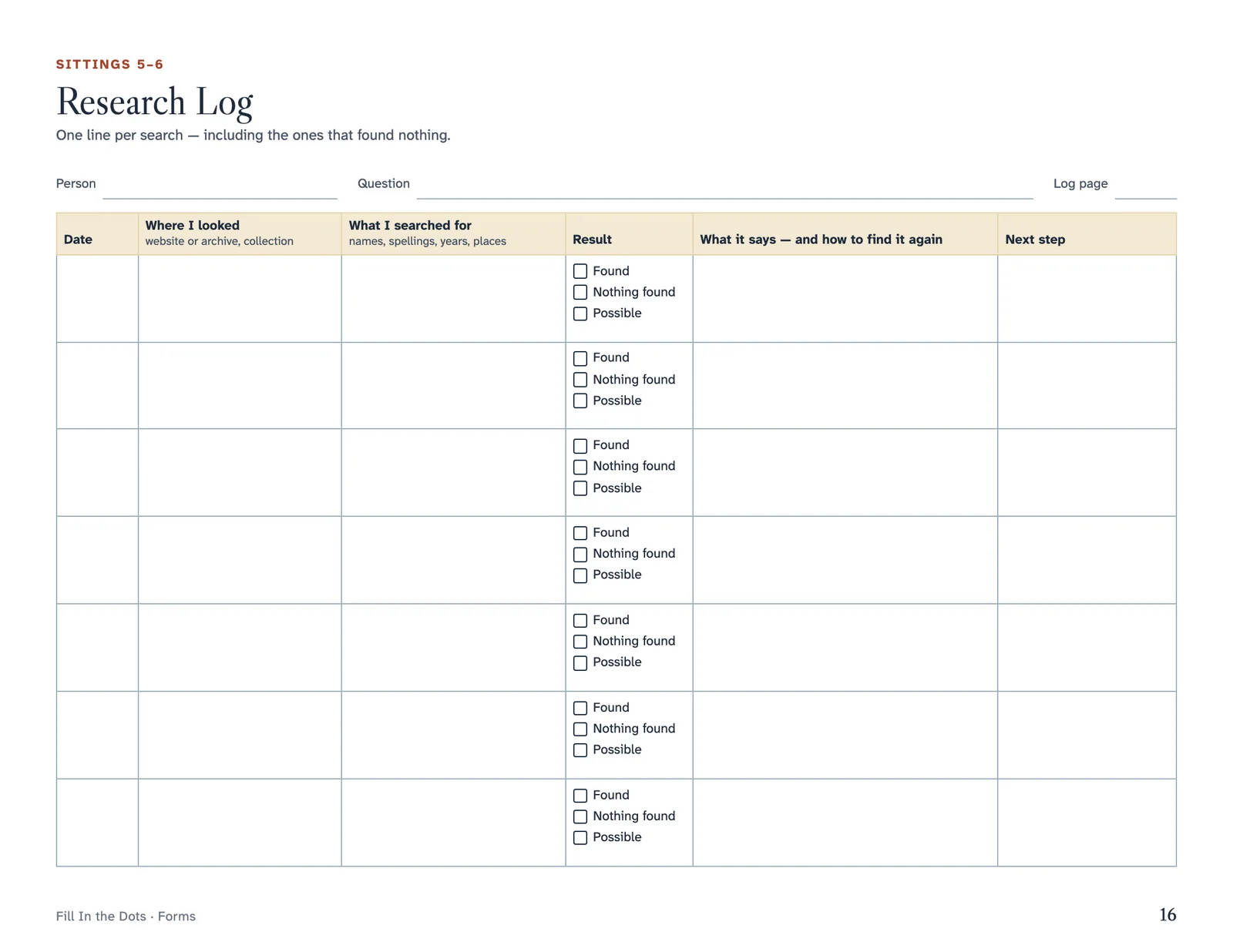
Your log, a people list, open questions and the whole directory, as a spreadsheet you can sort and filter.
Spreadsheet (.xlsx) · 7 tabs
| File | Format | Length | Size |
|---|---|---|---|
| The Guide — US Letter | 50 pages | 769 KB | |
| The Guide — A4 | 48 pages | 716 KB | |
| Forms to print or type — US Letter | PDF, fillable | 21 pages | 1.7 MB |
| Forms to print or type — A4 | PDF, fillable | 21 pages | 1.8 MB |
| Free Records Directory — US Letter | 54 pages | 855 KB | |
| Free Records Directory — A4 | 50 pages | 846 KB | |
| Research Workbook (spreadsheet) | Spreadsheet (.xlsx) | 7 tabs | 56 KB |
We opened every PDF in Chrome, in Firefox, and with Apple’s PDFKit, the software Preview and Safari use to show PDFs on a Mac. In Firefox and with PDFKit, we typed into the forms, filled the circles, saved them and opened them again: the entries were still there.
It’s an .xlsx file, the standard Excel format. We opened and checked it in Apple Numbers and LibreOffice Calc.
Made for home printers. Black and white is fine: the marks are shapes, not colors.
Adobe Acrobat Reader, Microsoft Excel, Google Sheets, phones and tablets. Not sure about your device? The free sampler’s Starter Map has the same fillable fields as the kit’s, so try it there first.
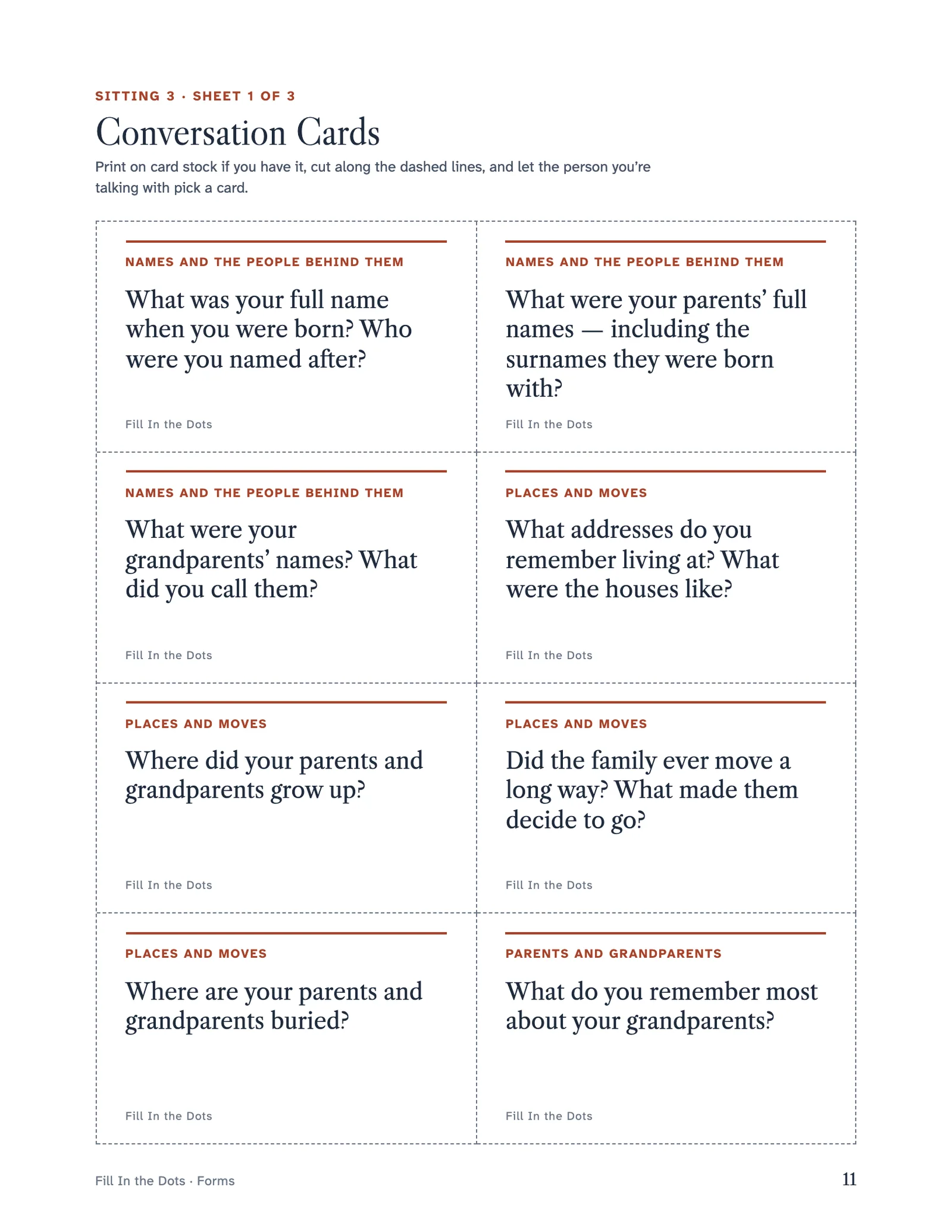
Clear type, room to write, and nothing that wastes printer ink. Select a page to see it larger.
The basics are forms, questions, free places to search, and a plan. Most of the forms are free: the FamilySearch Research Wiki links to blank pedigree charts, family group sheets and research logs from FamilySearch, the National Archives and Ancestry. What a kit adds is the order to do things in, and help at every step.
| You need | Free elsewhere | In Fill In the Dots |
|---|---|---|
| A pedigree chart | FamilySearch, the National Archives and Ancestry, and our free Starter Map | The Starter Map, with a mark beside every date and place |
| Family group sheets | FamilySearch, the National Archives and Ancestry | Family Pages for each couple and their children |
| A research log | FamilySearch and Ancestry, and our free research log | The Research Log form, and a workbook you can sort and filter |
| Questions to ask relatives | Our 55 free interview questions | An Interview Record and 24 conversation cards |
| Free places to search | The FamilySearch Research Wiki, and our free websites guide | 117 sources, each labeled with what you can do without paying |
| A plan, in order | Beginner guides from the Library of Congress and FamilySearch | Seven sittings of about 45 to 60 minutes, each with a worked example |
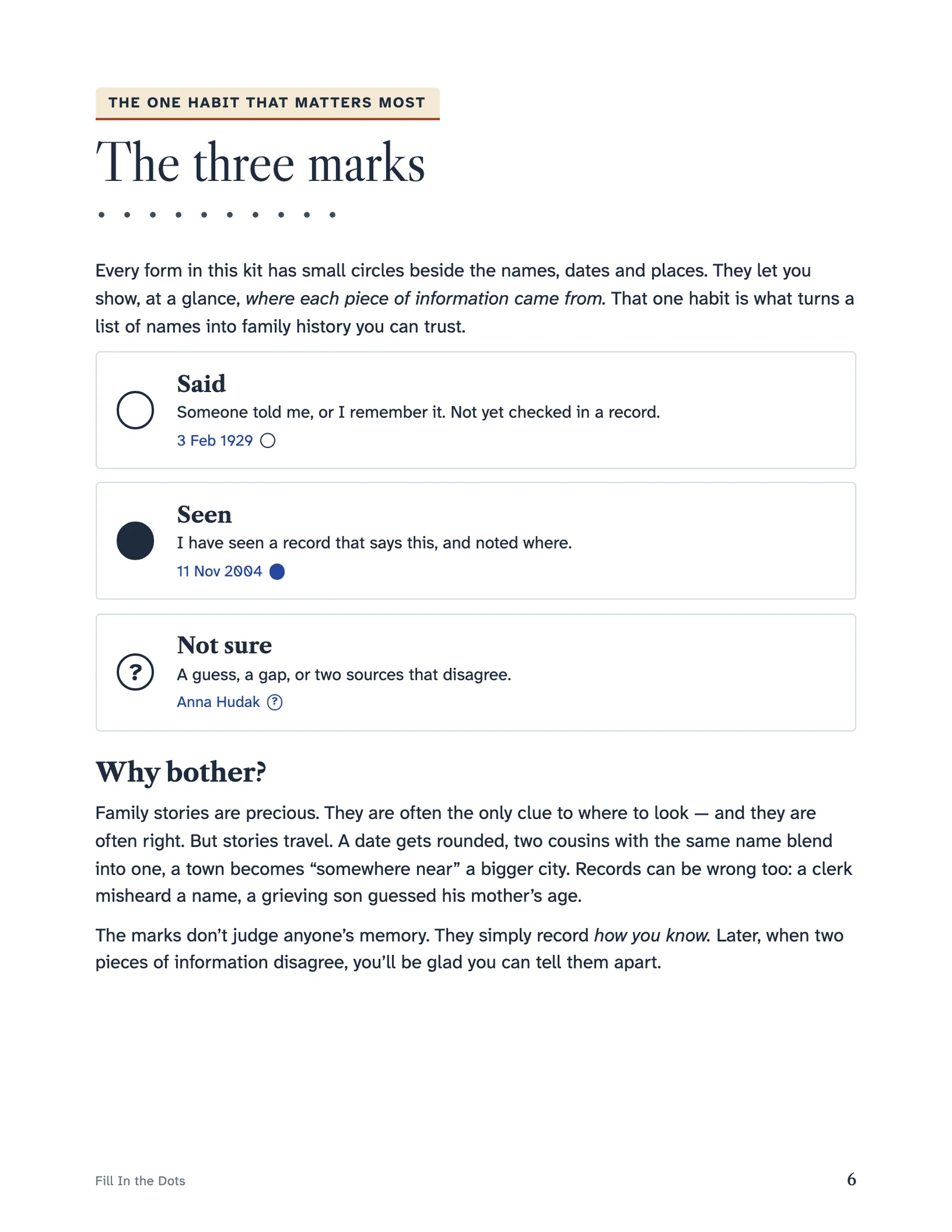
Family stories are precious, and they drift as they’re retold. Records can be wrong too. So beside every name, date and place on every form, there’s a small circle that shows how you know it.
Try it
“Grandma Anna’s maiden name was Hudak.”
How do you know?
Choose an answer to see which mark it gets.
From the kit’s fictional example family.
Each sitting takes about 45 to 60 minutes and has one goal and one or two forms. Do one a day, one a weekend, or one whenever you have a quiet hour. Every step has a worked example using a clearly labeled fictional family. After the seventh, you have the whole method: plan, search, log and weigh, and a next question to start again.
One box or folder of family papers and photos, and a list of what’s in it.
A four-generation Starter Map, filled in from memory, with every fact marked.
One conversation, written up, and a short list of things to check.
One person, one question records can answer, and where to look first.
Your planned searches done, including the ones that find nothing.
A research log you can trust, and your first filled-in dots.
Disagreements thought through, and your next question chosen.
Some sites let you search for free, then charge to see the record. Others are free, but only with an account, or only on a library computer. The directory lists 117 sources across the United States, Canada and the countries many families came from, and answers four questions about each one:
Each entry was checked on the site’s own pages. This edition was checked up to 8 October 2026.
The best free starting point for almost any family history search, from census records to church registers.
Finding your parents or grandparents in the most recent census that is open to the public (1950).
Using census images and old county history books free from home with your library card.
A sample of 16 sources. The full directory in the kit has all 117, with notes and tips for each.
US$27, paid once. No subscription, and no account needed to buy. Print the forms as often as you like for yourself and your family, or for a class or reunion you lead.
US$27one payment, instant download
30-day refund. If the kit isn’t useful to you, reply to your Gumroad receipt email within 30 days of purchase and ask for a refund. You’ll get your money back — you don’t need to explain or return anything.
Before you buy, see what it works with. Buying it for someone? Choose “Give as a gift” at checkout, and Gumroad emails them the download link (Gumroad Help Center).
Fill In the Dots is made by Wren & Co., and isn’t connected with FamilySearch, Ancestry or any archive, library or website it mentions.
The guide’s method follows published guidance from national archives, libraries and genealogy standards bodies, and lists all 30 sources it relied on.
Each of the 117 directory entries was checked on the site’s own pages and shows the date it was checked. This edition was checked up to 8 October 2026.
Every file was opened and checked before release. What it works with lists exactly where, and what we haven’t tested yet.
Fill In the Dots teaches a method and gives you forms, a workbook and a directory of free record sources. It does not include records about your family, a subscription to any website, DNA testing, or professional research. What you find depends on what records survive and are online for your family.
This site sets no cookies and counts visits with Cloudflare Web Analytics, which stores nothing in your browser. You pay on Gumroad’s secure checkout, so your card details go to Gumroad, not to us. For help, reply to your Gumroad receipt email.


The three marks, a blank Starter Map you can print or type into, twelve questions to ask your relatives, and six free places to start searching. No email address needed, and you’re welcome to share it.
Already bought the kit? See Find your files, or contact us.
Yes, and they’re good. FamilySearch, the National Archives, Ancestry and others offer free blank charts. What the kit adds is the order to do things in, plain instructions with a worked example on every step, the three marks, and a directory that labels exactly what each source lets you do for free.
No. The kit is built around sources that are free to use: FamilySearch, national archives, libraries and volunteer projects. The directory labels what each one lets you do without paying. If you ever decide a subscription is worth it, the guide explains how to try one without being caught by an automatic renewal.
Yes. The first four sittings use only paper and conversation. When you do go online, the guide walks you through making a free FamilySearch account and how search forms work, in plain words. Everything can be printed.
Yes. The forms PDF has 1,129 fillable fields: click a line to type, and click a circle to fill it. In Firefox and with PDFKit, we typed into the forms, filled the circles, saved them and opened them again: the entries were still there. The Research Workbook is a spreadsheet, if you’d rather type everything.
Every PDF comes in US Letter (for the United States and Canada) and A4 (for most other countries). The pages are designed for home printers, and black and white is fine. Print at “Actual size” or 100%.
Yes. Writing lines are about a third of an inch (8 mm) apart, the boxes on the Starter Map leave room for full names, and you can print as many copies of any form as you need.
You can read the PDFs on a phone or tablet, and Gumroad’s download page has a Read button that opens them in your browser. The forms and the workbook are easier on a computer or on paper. We haven’t tested typing into the forms on phones or tablets, so try the free sampler’s Starter Map on yours first: it has the same fillable fields as the kit’s.
It works beside them. The kit is PDFs and a spreadsheet, so nothing syncs or imports. Use the forms and log for your research notes, and keep your tree wherever you like.
It’s written for people in the United States and Canada, with both countries’ records covered in the guide and the directory. Because so many families came from somewhere else, the directory also includes free record sites for England and Wales, Scotland, Ireland, Germany, Italy, Poland, the Netherlands, Scandinavia, France and Portugal, and starting points for Mexico and other countries.
They’re designed for real families. Partners don’t have to be married, children can be marked as birth, adopted, step or foster, and you can keep a separate map for a birth family and an adoptive family. The guide also has a section on handling unexpected discoveries kindly.
Seven sittings of about 45 to 60 minutes each. Do one a day, one a weekend, or whenever you have a quiet hour. There’s no deadline and no test, and after the seventh you can keep going with the same method.
Briefly and carefully. The guide explains what a DNA test can and can’t tell you, what to think about before testing, and why it doesn’t replace records. It isn’t a DNA guide, and no test is included.
No. Every example follows one invented family, labeled as fictional wherever it appears, so you can see how each form and search works without anyone’s private history being used.
Checkout happens on Gumroad, the platform that sells and delivers the kit. As soon as payment goes through, Gumroad shows your download page and emails you a receipt with a link back to it. You don’t need to create an account. Keep that email: its link always brings you back to your files.
The price is US$27. Gumroad’s checkout shows the equivalent in your local currency (you can switch back to US dollars) and adds any sales tax or VAT that applies where you live. When we checked from Ontario on 8 October 2026, it showed about CA$38, plus about CA$5 in tax. The exact amount follows the exchange rate on the day.
Yes. At checkout, switch on “Give as a gift” and enter their email address, with a personal message if you like. Gumroad emails you the receipt and emails them the download link, so tell them to look out for it. If you’re doing it together, one copy is enough: you can print the forms for yourself and your family. One person asks the questions, the other writes things down, and the first four sittings need only paper and conversation.
If the kit isn’t useful to you, reply to your Gumroad receipt email within 30 days of purchase and ask for a refund. You’ll get your money back — you don’t need to explain or return anything.
Yes. Print as many copies of the forms as you like for yourself and your family, and work on your family history together. If you lead a class, workshop or family reunion, you may print copies of the forms for the people taking part. Please don’t post the files online or resell them. The free sampler, on the other hand, can be shared with anyone.
Each directory entry shows the date it was checked. If a link stops working, search for the site’s name, and tell us by replying to your receipt email so we can correct it.
Seven guides from the kit’s research, and the sampler, free to read, print and share.
What’s free to search, what’s free to see, and what needs an account, for 26 sources.
Read the guide55 open questions by topic, a printable copy, and what to do with the answers.
Read the guideA free one-page log to print or type into, with a filled-in example.
Read the guideSeven first steps, all free, from what you already know to your first records.
Read the guideA four-generation chart to print or type into, with a filled-in example.
Read the guideWhich census years are open, where each is free, and what each one tells you.
Read the guideA two-page sheet for one couple and their children, to print or type into.
Read the guide7 pages from the kit: the three marks, a Starter Map, twelve questions and six free places to search.
Get the samplerWren & Co. began in 2026 with one aim: to make well-made helpers that bring order to everyday life. Life gets messy: bills arrive on the wrong days, plans scatter, memories slip away. Each thing we make takes one of those tangles and makes it tidy, clear and easy to come back to. No jargon, no clutter, just quiet, useful tools that do their job well.
An educational guide and set of templates. No records are included, and no discoveries are promised.